
What an Adjuster's Job Actually Is
Before walking through what they look for, it helps to understand who's standing on your roof. There are three different kinds of adjusters that may show up at your home:
Company Adjusters
These are full-time employees of your insurance company. They settle the claim based strictly on your policy terms and the damage they document. You don't pay them — they're paid by your insurer. Most claims in northern Illinois are handled by company adjusters when storm volume is normal.
Independent Adjusters
These adjusters are contracted by insurance companies, often during high-volume periods after major storm events. After a significant hailstorm sweeps through northern Illinois, your insurer may not have enough staff adjusters to keep up — so they bring in independents. The independent adjuster's job is the same as a company adjuster's, but they may be working for several different carriers and have different schedules.
Public Adjusters
These adjusters work for you, not the insurance company. You hire them, and they typically charge 10% to 15% of the final settlement. Public adjusters can be valuable on complex or high-value claims that have stalled, but they're not necessary for most straightforward storm damage claims if you have solid contractor documentation.
For the rest of this article, when we say "adjuster," we mean the company or independent adjuster sent by your insurance company.
Insurance adjusters are not looking for as much damage as possible. Their job is to assess whether the damage meets the threshold for a covered loss, and to document a defensible scope at the lowest reasonable cost. That's not adversarial — it's just the job. Knowing how they work lets you make sure they see everything they should.
The Test Square Method
The single most important methodology to understand is the test square. This is how adjusters quantify hail damage on a roof in a way that produces consistent, defensible documentation.
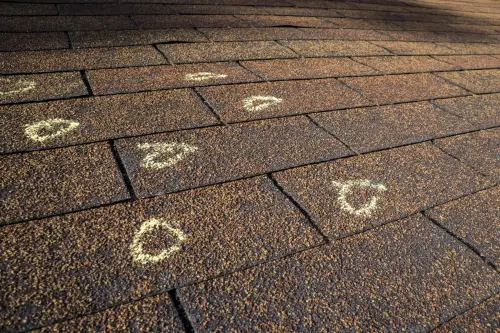
Here's how it works: the adjuster marks off a 10-foot by 10-foot square on each major slope of your roof using chalk or marking spray. Within each test square, they count the number of hail impacts that meet their criteria for "functional damage" — meaning impacts that have actually compromised the shingle, not just bounced off harmlessly.
The number of qualifying hits within each test square determines whether that slope of roof qualifies for replacement. The threshold varies by insurance company, but eight hits per test square is a common benchmark. Some carriers use six. Some use ten. The threshold is rarely written into your policy explicitly — it's a claims-handling guideline.
What "functional damage" actually means
Not every mark on a shingle is functional damage. The adjuster is specifically looking for impacts that have:
- Fractured the underlying fiberglass mat
- Displaced protective granules in a defined impact pattern
- Created a bruise that can be felt as a soft spot when pressed
- Cracked the shingle outright
- Compromised the shingle's ability to shed water over its remaining lifespan
Surface scuffs, cosmetic marks, and impacts that didn't compromise the shingle structure typically don't count toward the functional damage threshold. This is one of the most common points of disagreement between homeowners and adjusters — what the homeowner sees as "damage" and what the adjuster classifies as "cosmetic" can be very different.
Why the test square location matters
An adjuster who marks test squares only on slopes that took less direct hail exposure can produce a lower hit count than the actual storm pattern justifies. A skilled contractor walking the roof with the adjuster will identify the slopes that took the heaviest exposure (typically west-facing or south-facing in northern Illinois storm patterns) and ensure those are tested. This alone can be the difference between a partial repair and a full replacement.
The Specific Impact Markers Adjusters Look For
Beyond the test squares, adjusters are trained to identify specific physical evidence of hail impact across multiple roof components. Here's what they're examining and why each matters:
Granule Loss in Defined Patterns
Asphalt shingles are protected by a mineral granule layer that shields the underlying asphalt from UV degradation. When hail strikes a shingle hard enough, it knocks granules off in a roughly circular pattern around the impact point. Adjusters look for:
- Circular bare spots roughly the size of the hailstone that fell
- Defined impact rings rather than generalized weathering loss
- Granule accumulation in gutters, downspout outlets, and on the ground at the base of downspouts
Generalized granule loss across an entire shingle surface is usually attributed to age. Localized circular loss patterns with corresponding accumulation in gutters tells the storm damage story.
Shingle Bruising
This is what most people don't realize you can't see from the ground. A hail bruise is a soft spot on the shingle where the impact has fractured the fiberglass mat underneath without breaking the surface. To find it, the inspector presses on suspicious areas with their fingertip — a bruise feels distinctly soft, similar to pressing on a bruised piece of fruit.
Bruising is among the most important hail damage indicators because it confirms that the impact compromised the shingle's structural integrity. A roof with widespread bruising will fail prematurely even if no individual shingle has split open yet.
Cracked or Fractured Shingles
Larger hailstones — typically 1.5 inches or greater — can split shingles outright. Adjusters look for fresh, sharp-edged cracks that haven't weathered. An old crack will have collected dirt and debris and weathered edges. A fresh storm-event crack will be clean.
Soft Metal Damage (Critical Evidence)
This is one of the most powerful pieces of supporting evidence in any hail claim, and it's often overlooked by homeowners. Soft metals dent. Asphalt shingles can sometimes hide damage. Soft metals can't.
Adjusters specifically check:
- Aluminum gutters and downspouts for dents and impact dimples
- Roof flashing — drip edge, valley flashing, step flashing — for impact marks
- Furnace and plumbing vent caps
- HVAC condenser unit fins (often badly damaged in significant hail events)
- Aluminum window screens
- Mailboxes and metal exterior fixtures
If the soft metals on your property show clear, fresh hail dimples, that establishes the storm event happened and the impact size. From there, an adjuster cannot reasonably argue the roof escaped unscathed if the gutters didn't.
Wind Damage Indicators
Wind damage is documented separately from hail and follows different patterns. Adjusters look for:
- Lifted shingles where the sealant strip has broken but the shingle remained attached
- Creased shingles where wind folded the shingle, breaking the mat at the crease line
- Missing shingles in distinctive patterns starting at corners and edges where uplift forces are highest
- Broken or torn shingle tabs
- Damaged ridge and hip caps
Wind damage and hail damage often occur in the same storm and are both claimable, but adjusters document and price them separately. A skilled contractor walking the roof with the adjuster ensures both get full attention rather than one masking the other.
Soffit, Fascia, and Gutter Damage
Adjusters check these components as part of a complete inspection, but they're sometimes glossed over when the focus is the roof itself. Damage here is fully claimable when storm-related and should be documented:
- Cracked or split fascia from wind-driven debris or ice impact
- Damaged soffit panels
- Bent or detached gutters
- Disconnected downspouts
What Adjusters Will Try to Discount
Adjusters are also trained to identify damage that is not covered — and to flag it before it becomes part of the claim. Knowing what they'll point to as exclusionary helps you understand why some items get pushed out of scope.
Pre-Existing Wear and Aging
The most common pushback. Adjusters look for:
- Curled shingle edges (sign of aging and ventilation issues, not hail)
- Buckling shingles (substrate or ventilation issues)
- Generalized granule loss across entire shingle surfaces
- Algae streaking or moss growth (long-term moisture issue)
- Rusted nails and corroded fasteners
A roof showing significant pre-existing wear before a storm will face more skepticism on a hail claim. This doesn't mean the storm damage isn't covered — Illinois follows the "efficient proximate cause" doctrine, meaning if the storm was the primary cause of the loss, coverage applies even if some pre-existing wear was present. But it does mean the documentation needs to clearly distinguish storm-event damage from age.
Improper Installation
Adjusters check for:
- High nailing (nails placed above the manufacturer's nailing strip)
- Insufficient fasteners per shingle
- Missing or improperly installed flashing
- Inadequate underlayment
Damage caused by improper installation is generally not covered. This is one reason adjusters take particular interest in roofs that show signs of DIY work or work done by unlicensed contractors.
Deferred Maintenance
Cracked pipe boots, neglected flashing, missing caulking, debris accumulation in valleys — all classified as maintenance issues. The line between maintenance and storm damage isn't always crisp, and this is another area where contractor documentation matters. A pipe boot that's clearly been pummeled by hail and a pipe boot that simply aged out look different to a trained eye.
Cosmetic-Only Damage
This is a growing area of policy exclusion in Illinois. Some 2026 homeowner policies exclude "cosmetic-only" hail damage that doesn't impair the roof's function. The exclusion gets used to deny claims where the impacts are documented but the adjuster classifies them as not affecting the shingle's ability to do its job. Pushback on this classification often requires a contractor inspection report that documents specific functional damage indicators — bruising, granule displacement in defined patterns, mat fracture — that meet the policy's coverage criteria.
When the Damage Justifies a Full Roof Replacement
Adjusters don't replace roofs casually. A scope of loss for a full roof replacement requires meeting specific criteria, which generally include some combination of:
- Eight or more functional damage hits per test square on multiple slopes
- Damage spread across more than just one slope or section
- Roof age and condition that makes spot repair impractical or visually unmatched
- Inability to source matching shingles for partial replacement (a real factor — shingle product lines change frequently and exact color matches on a 10-year-old roof are often impossible)
Many adjusters will initially scope only the most visibly damaged slope, which sets up the roof for a partial replacement. A contractor walking the roof can identify whether the unmatched-shingle issue, age of the roof, and damage distribution should bump the scope to a full replacement. This is one of the highest-value moments in the claims process — the difference between a partial and full scope can be $8,000 to $15,000.
How to Prepare Your Home for the Adjuster Visit
The few days before the adjuster shows up are when homeowners can have the most impact on the outcome. Here's what to do:
Get Your Contractor Inspection First
This was covered in detail in our insurance claim process guide, but it's worth repeating: a thorough contractor inspection report — with documented hits per slope, photos with location reference, soft metal damage evidence, and storm event date confirmation — is your single most valuable preparation tool. Without it, you're walking into the inspection blind. With it, you have a parallel document to compare against the adjuster's findings.
Photograph Soft Metal Damage Yourself
Walk your property and photograph every dent on every soft metal surface. Gutters, downspouts, AC condenser fins, vent caps, mailboxes, exterior light fixtures. Take wide shots and close-ups with scale references (a coin or measuring tape). This evidence is often the strongest single piece of documentation in a hail claim because soft metals don't lie about whether a storm event occurred.
Document Interior Damage
New ceiling stains, water spots, attic moisture, lifted insulation — anything inside the house that wasn't there before the storm. Adjusters often don't go into attics or check upstairs ceilings unless directed. Have those photos ready and ask the adjuster to look at them.
Pull NOAA Storm Data for the Event
The NOAA Storm Events Database and HailTrace both maintain searchable records of hail size, wind speed, and storm path by date and location. Pull a printout that confirms a storm event with measurable hail occurred at your address on the date in question. We attach this to every inspection report we produce — but if you're going alone, you can pull it yourself at no cost.
Have Your Contractor Present
This is the single highest-leverage decision you can make. Insurance adjusters and contractors typically work together professionally during inspections — both are doing technical assessments of the same roof. Having an experienced contractor on the roof at the same time as the adjuster ensures every documented impact gets pointed out, every damaged component gets included in the scope, and the adjuster has a knowledgeable counterpart to discuss findings with.
Homeowners who meet adjusters alone and then ask their contractor to estimate after-the-fact often find the adjuster's scope is missing items the contractor would have caught in real time. Once the scope of loss is written, getting items added requires a supplement — which is harder than getting them included originally.
Signs Your Inspection Missed Something
If you've already had your adjuster visit and you're reviewing the scope of loss before the work begins, watch for these red flags that suggest items were missed:
- Only one or two roof slopes scoped on a multi-slope roof after a hailstorm that hit your entire neighborhood
- No mention of soft metal damage when your gutters and AC unit clearly show impact dimples
- No code-required upgrades like ice and water shield underlayment, drip edge, or modern flashing details
- No starter strip or ridge cap allowance — these are required for any new roof installation
- No allowance for overhead and profit on a multi-trade replacement project
- Spot repairs scoped on a roof more than 10 years old where shingle matching will be impossible
- No interior drywall or insulation allowance when there's documented water intrusion
Any of these signals it's time to file a supplement with documented justification for the missing items. A good contractor handles supplement preparation as part of their storm damage service.
Common Adjuster Questions to Be Ready For
Adjusters will ask questions during the inspection that are part of their documentation process. Some of these are routine — others are looking for answers that could affect coverage. Be prepared to answer:
"When did you first notice the damage?"
The closer to the storm event, the better. "I noticed it the morning after the storm" is the strongest answer. "I noticed it about three months later" can open the door to questions about whether the damage actually came from that specific storm event.
"Was the roof in good condition before the storm?"
Be honest. If the roof was 18 years old, say so — but emphasize that it was performing properly and not leaking. Adjusters know roof age. Lying about it doesn't help and undermines your credibility on everything else.
"Have you had any previous hail or wind damage claims on this property?"
If yes, be straightforward about it. This information is in the CLUE database and your insurer will pull it regardless. The honesty matters more than the answer itself.
"Has any work been done on the roof recently?"
If yes — repairs, partial reroofing, gutter replacement — say so. Recent work isn't disqualifying, but undisclosed work can become an issue if it's discovered later.
How We Help When the Adjuster Visits
Walking the roof alongside the adjuster is one of the most important things we do as part of our storm damage repair service. Here's what that looks like in practice:
We arrive before the adjuster and review our inspection report with you. We walk you through the documented hits, the soft metal evidence, the storm data, and what we expect the adjuster to look at. When the adjuster arrives, we introduce ourselves and ask to walk the roof together — which is standard professional practice and rarely refused.
On the roof, we point out documented impact patterns slope by slope. We identify code-required upgrades that the scope needs to include. We bring up secondary damage like gutters, soffits, and HVAC condensers if those got hit. If there's a question about whether a particular impact qualifies as functional damage, we discuss it on-the-spot rather than letting it disappear into a scope of loss document we never see in real time.
After the adjuster leaves, we review the scope of loss they produce against our inspection report. If items are missing, we prepare the supplement documentation with photos, code references, and pricing — and submit it on your behalf.
Ready for Your Inspection?
If you suspect storm damage to your roof, the right move — before calling your insurance company, before scheduling an adjuster — is a thorough independent inspection from a contractor who knows the northern Illinois insurance landscape. Our inspections are free, written, and documented to insurance-claim standards. We'll tell you whether you have a claim worth filing, what to expect from the adjuster, and what code upgrades and secondary items to make sure get included.
Call us at (815) 636-6446 or request an inspection online. We serve homeowners across Loves Park, Rockford, Machesney Park, Belvidere, and 14 other northern Illinois communities. For a complete walk-through of the claim process from start to finish, see our insurance claim process guide. For more on our full storm damage repair services, including emergency response and full insurance documentation support, follow the link.